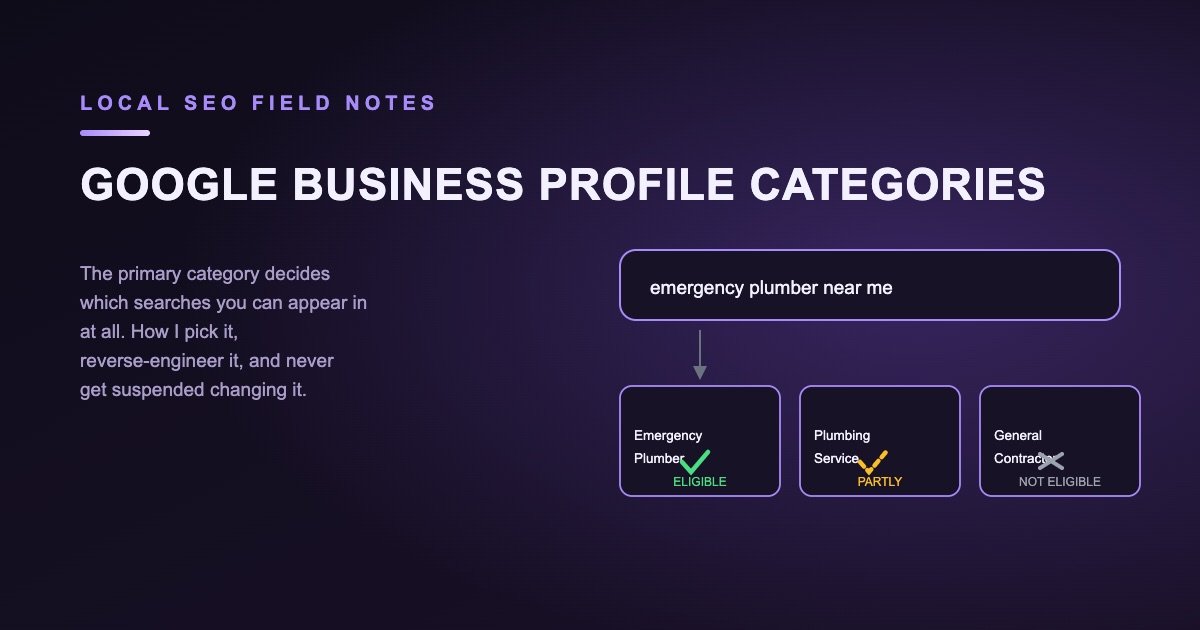
Google Business Profile Categories: How to Pick a Primary That Actually Wins Searches
If I could only fix one thing on a local business's profile, I would fix the primary category every single time.
That preference comes from data rather than habit. In Whitespark's 2026 Local Search Ranking Factors survey, forty-seven local SEOs scored 187 signals, and the primary category came out at number one for local pack visibility. It beat proximity, reviews and links. Eight of the top ten pack factors came straight from the Business Profile.
Most owners still choose a category in about eleven seconds during setup, then never look at it again.
A category is a classification, not a keyword
This distinction matters more than anything else in this article.
When you type words into your GBP description, you are adding text. Google may or may not weight it. For what it is worth, "keywords in GBP description" scored near the very bottom of the 2026 factor list at 171 out of 187.
Selecting a category does something different. You are attaching your business to a node in Google's business taxonomy. There are over four thousand of these nodes, and Google adds, splits and retires them regularly. That taxonomy is machine readable in a way free text never is. It behaves more like a structured entity type than a keyword.
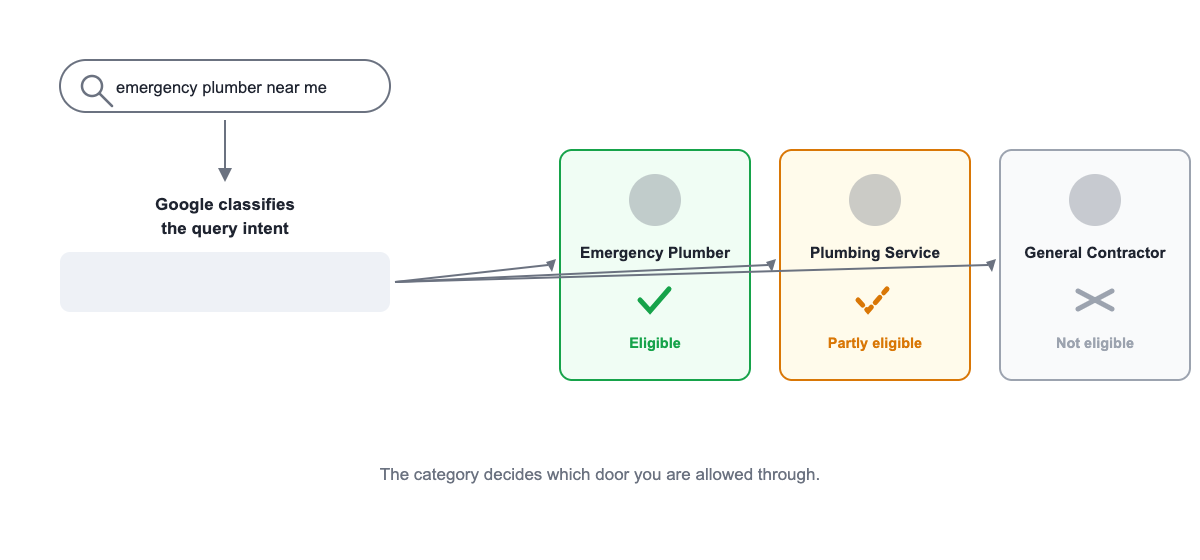
So the practical question is not which words you want to rank for. It is which query intents Google considers this category eligible to answer.
That is why I described the primary category as a gate rather than a lever in my breakdown of the three gates every local business has to clear. If your category does not match the class of business the query is asking for, no amount of reviews or links will smuggle you in.
Primary and additional categories do different jobs
You get one primary and up to nine additional categories.
The primary category carries the most ranking weight, decides which profile features you unlock, and effectively defines what your business is. It ranked first overall in the 2026 data.
Additional categories widen the set of queries you can appear for. They ranked eighth, which is still high, and it means secondary categories are not decoration.
In practice, a business set as Dentist with an additional category of Cosmetic Dentist competes hard for general dentist queries and gets partial eligibility for cosmetic ones. Flip them, and the whole profile's centre of gravity moves. Same ten categories, very different outcome.
I have seen this flip alone reorder a local pack. A clinic that wanted implant work was set to Dental Clinic as primary, with implants buried at position four in the additional list. We moved the implant category to primary and left general dentistry as an additional category. The implant queries improved within about two weeks, while general "dentist near me" visibility softened slightly. That trade was exactly what the client wanted, because an implant case was worth roughly twenty times a check-up.
That trade-off is the real decision. Choosing a primary category also means choosing what to be less visible for. Anyone who tells you a category change is pure upside has not run enough of them.
How specific should you go
Google's own guidance is to use the fewest categories that describe your core business. I mostly agree, with one caveat.
My rule is simple. Make the primary as specific as the truth allows, and add secondary categories only where a real service sits behind them.
Personal Injury Attorney beats Lawyer for injury queries. Emergency Plumber beats Plumbing Service for urgent ones. Specificity works because it removes ambiguity. You are handing the classifier a cleaner signal instead of asking it to infer your niche from context.
Specificity does have an edge case. If a hyper-specific category has almost no search demand behind it, you can classify yourself into a corner. I check this before switching by looking at whether Google's local packs even fire for those queries. If a query returns a plain organic page with no map, the category is not buying you pack visibility.
On volume, older BrightLocal research suggested profiles with around five total categories tended to perform best on average, with diminishing returns beyond that. I treat that as a rough sanity check rather than a law. What I actually enforce is my own rule: no category without a real service and a real page behind it.
Reverse engineering competitors
Guessing at categories is unnecessary. You can look at what is already winning.
Here is the process I run for every new local client.
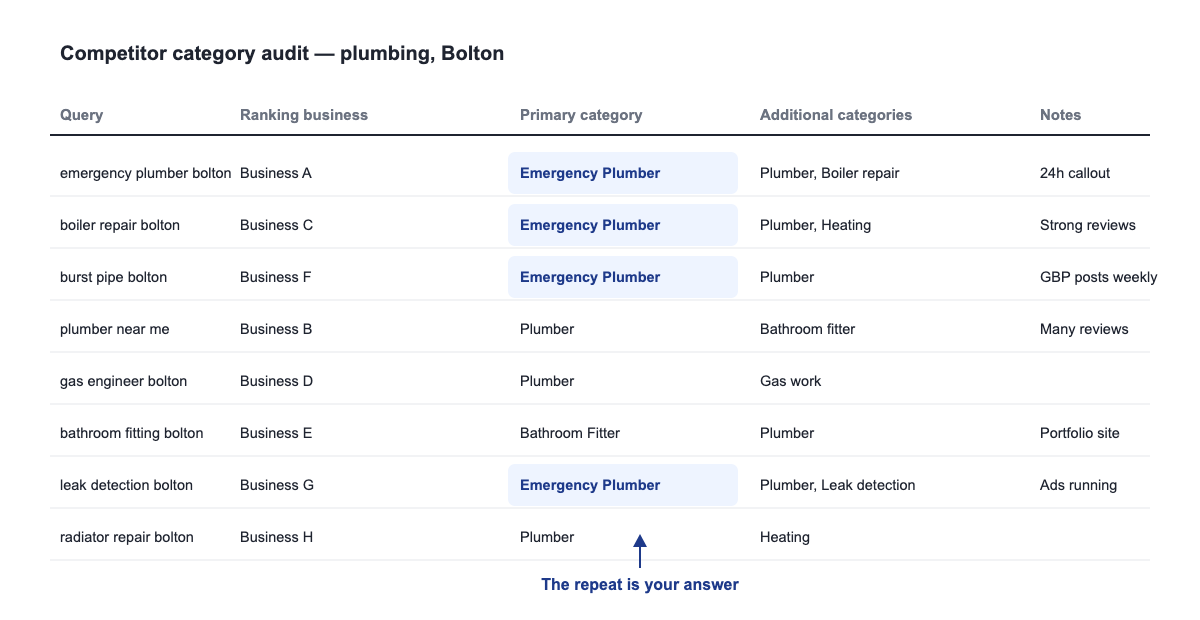
1. Build the query set. Write down the ten to fifteen searches that actually produce revenue. Not the vanity head term. The ones with money attached.
2. Run each query from a real location. Use a grid tool or a location emulating browser. Do not use your own logged-in browser, because personalisation will lie to you.
3. Record the top three profiles for each query. You now have a pattern rather than an opinion.
4. Pull their categories. Several free browser extensions expose the primary category on a Maps listing, and the category is also visible in the page source. Note the primary specifically, not just the one Google chooses to display.
5. Look for the repeat. If seven of your fifteen money queries are dominated by profiles sharing one primary category, that category is your answer. Not because it is clever, but because Google has already told you which classification it associates with those intents.
6. Check what the category makes possible. Different categories unlock different profile fields, including booking buttons, menus, service lists and attributes. Sometimes the field access is worth more than the ranking shift.
This takes about an hour. I have never regretted the hour.
The category, service and page triangle
This is the model I use to keep a profile coherent, and it separates a profile that holds its rankings from one that wobbles.
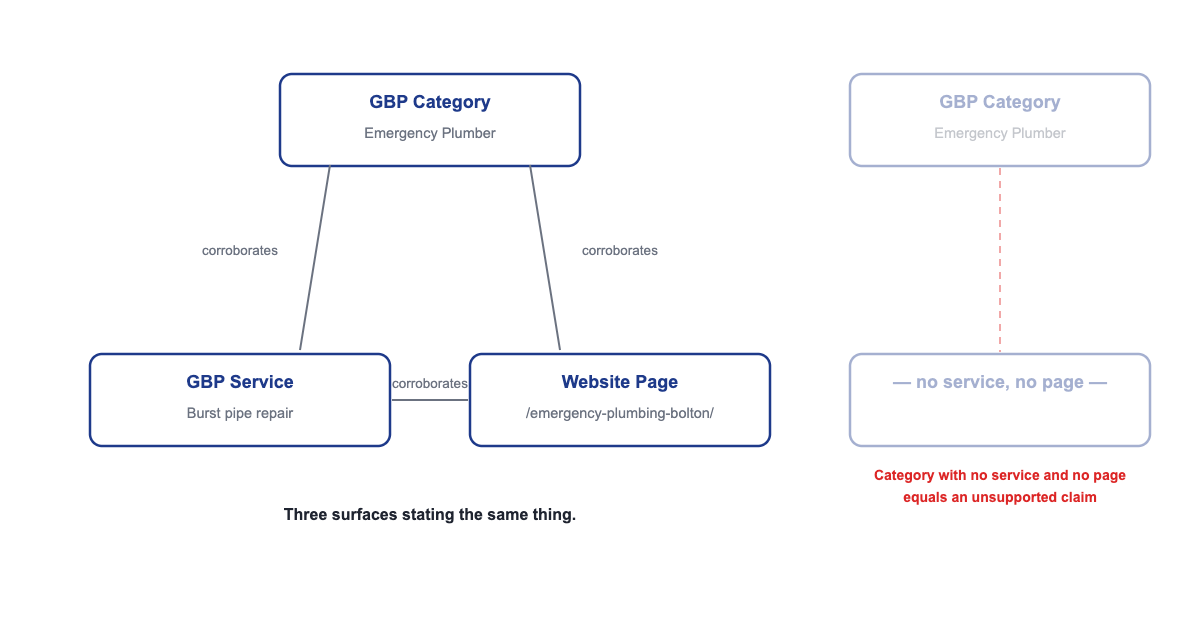
For every category you claim, two other things have to exist.
A matching service inside the profile. Predefined services entered the 2026 factor list at number twenty-two, which is remarkably high for a field most businesses ignore. Google suggests a set of predefined services once your category is set. Take all the relevant ones, then add custom services for anything you genuinely offer that the list leaves out.
A matching page on your website. "Dedicated page for each service" was the number one factor for local organic rankings in the 2026 data, and it also ranked twenty-fourth for the pack. That single factor appearing near the top of both lists is the clearest instruction in the whole report.
Category, service, page. All three, or none.
When these three agree, you are giving Google the same statement from three separate surfaces. That is corroboration, and corroboration is what entity based retrieval systems reward. When they disagree, meaning a category exists with no service and no page, you have created a claim with nothing supporting it. I have watched profiles with category-only claims fail to hold rankings for those queries at all.
If you are building out the third leg of that triangle, I have a full method for it in give each category a page that backs it up.
Category churn is a real risk
Google changes its category list constantly. Categories get renamed, split into narrower ones, or retired. When a category is retired, profiles sitting on it get moved to whatever Google considers the nearest surviving node, which is often something broader.
That means a profile you optimised perfectly eighteen months ago may now be sitting on a category you never chose.
I check categories on every quarterly audit for exactly this reason. It takes two minutes, and it has caught silent downgrades on real accounts.
Two more things to know about changing categories.
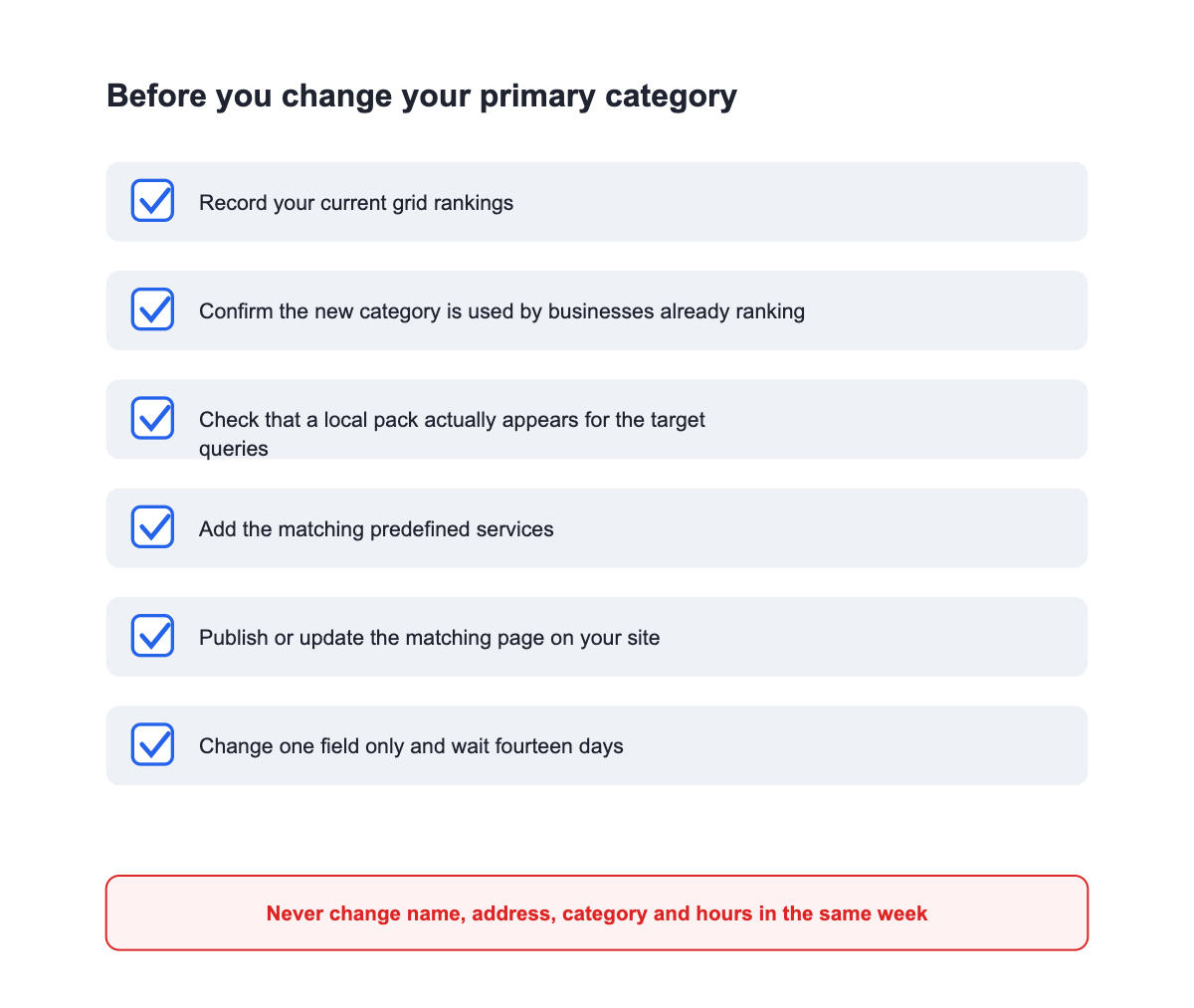
Do not bulk edit. Changing your name, address, primary category and hours in the same week is one of the clearer suspension triggers in local search. Change one thing. Wait. Watch. Change the next.
Expect a wobble. Rankings usually move within days after a primary change, sometimes down before up. Give it two weeks before you judge. If you panic and revert on day three, you have learned nothing and added another edit to your history.
Record your grid rankings before you touch anything, because without a baseline you will be arguing from memory.
Categories and AI search: a split worth knowing about
Here is a nuance that changes where you spend effort.
Darren Shaw made a sharp observation while completing his own 2026 survey. Scoring a factor like additional categories for AI search visibility depends entirely on which AI you mean. Google's AI Mode and Gemini have direct access to Business Profile data, so categories plausibly influence them. An external assistant like ChatGPT does not have that data feed, so a category means very little there.
The practical takeaway is that categories buy you Google surfaces, while mentions buy you everything else. If your customers are increasingly asking an assistant for a recommendation rather than searching Maps, your category work has a ceiling, and the next lever is coverage across the open web. I get into that in how AI assistants read your business data.
Category mistakes I see most often
Copying the biggest competitor's category without checking why they rank. Sometimes a national brand ranks despite a poor category because of overwhelming brand strength. Copy the pattern across several competitors, never a single one.
Adding all ten additional categories just in case. Every category you add for a service you do not really offer is a claim Google can fail to corroborate, and it dilutes what you are actually about. Ten thin claims is a worse signal than four strong ones.
Leaving the services section empty after setting the category. This is the most common gap I find, and it is free to fix in twenty minutes.
Setting the category and never touching the directories. Your classification on Apple Maps, Bing Places and major industry directories should describe the same business type. Inconsistent classifications create exactly the kind of conflicting data that weakens an entity record. That is part of matching your category across directories.
Treating category selection as permanent. Your business changes. A plumber who now makes 60% of revenue from bathroom installations is misclassified if the primary is still Plumber.
Frequently asked questions
How many Google Business Profile categories should I have? One primary plus roughly three to five additional, in most cases. The real test is not the number. It is whether each category has a matching service in your profile and a matching page on your site.
Will changing my primary category get me suspended? Changing one category on an established, verified profile is normal and low risk. Changing your name, address and category in the same week is not. Space your edits out.
Can I rank for a service that isn't in my category list? Sometimes, through services, review text and website content, but you are working uphill. If a service matters to your revenue, it deserves either a category or its own page, and usually both.
How do I find my competitor's primary category? Several free extensions display it directly on the Maps listing, and it is present in the listing's page source. Check three or four competitors rather than one, and look for the repeated pattern.
How long until a category change affects rankings? Days, usually. Profile fields move faster than reviews or links. Take grid screenshots before you change anything so you can measure honestly, and give it a full two weeks before judging.
Does my GBP description need keywords? Not for ranking, since that factor scored near the bottom of the 2026 list. Write it for humans, lead with a clear sentence stating what you are, where you are and who you serve, and keep it clean. Keyword stuffing the description is one of the higher suspension risks on record.
Category work is quick, cheap and genuinely high leverage, which is why it is usually the first thing I fix. If you would rather have it audited properly, with the competitor analysis and the service and page alignment done alongside it, that is the kind of project I take on at rohanalvi.com.