How Google Ranks the Local Pack (And How I Diagnose Why a Business Isn't In It)
Most people ask me the wrong question about local rankings.
They ask what the ranking factors are. There are close to two hundred of them if you go by Whitespark's 2026 Local Search Ranking Factors survey, where forty-seven local SEOs scored 187 separate signals. Knowing all 187 does not help you. I have never once fixed a client's map pack problem by reading a list.
The better question is which gate the business is failing.
Local search does not work like one big score. It works more like a series of checkpoints. If you fail the first one, nothing you do at the third one matters. This is the model I use on every audit, and it has saved me weeks on projects where someone had already spent six months buying links for a business that Google did not even treat as eligible for the query.
The three gates
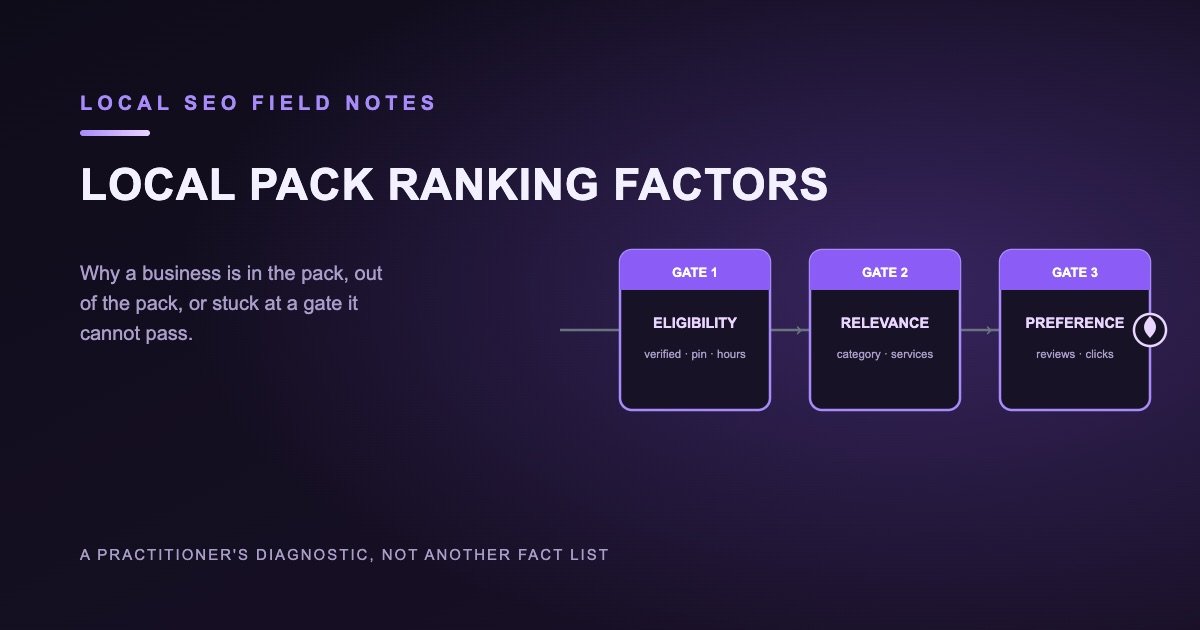
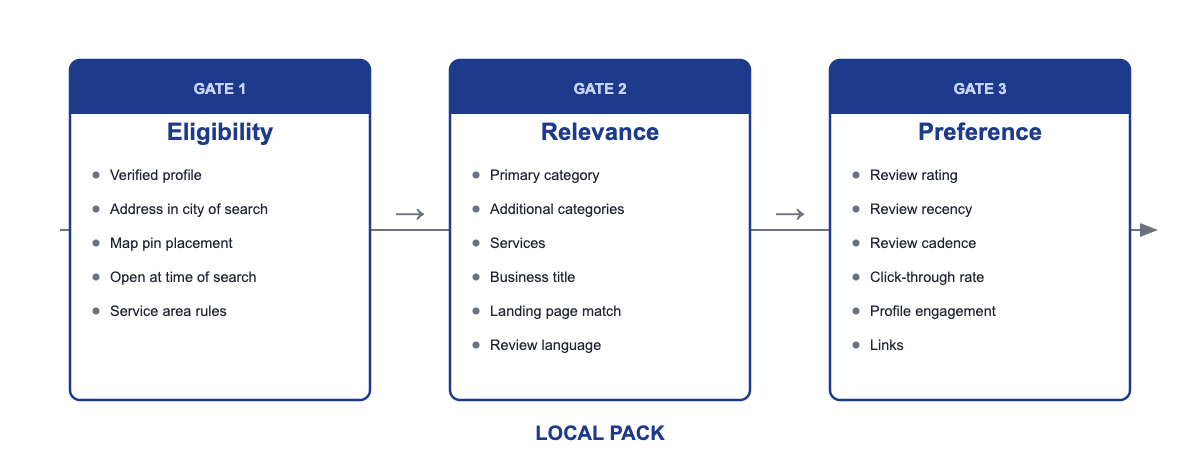
I sort every local ranking factor into three groups. I call them gates because you pass through them in order.
Gate 1, Eligibility. Can this business appear in this pack at all?
Gate 2, Relevance. Does Google understand this business as the kind of business the query is asking for?
Gate 3, Preference. Among the businesses that passed gates 1 and 2, why would Google pick this one?
Google's own public explanation of local ranking uses three words: relevance, distance and prominence. That framing is accurate, but it is not diagnostic. It tells you what matters. It does not tell you what to check first. The gate model does.
Gate 1: eligibility, the checks nobody enjoys
Eligibility problems are boring, and they are the most common thing I find.
The profile has to be verified and unsuspended. Obvious, and yet I have opened audits where the profile was sitting in a soft suspension state and the owner had no idea, because the listing still looked fine to them while logged in.
The address has to sit in the city being searched. In the 2026 survey, "physical address in city of search" ranked as the fourth most influential local pack factor, just behind proximity itself. A business in a neighbouring suburb is not competing on level ground for the city-name query, no matter how good its content is.
The map pin has to be in the right place. Pin placement sits at number ten on the same list. I have seen a pin dropped on the wrong side of a motorway pull a business out of an entire pack. Drag it, save it, then check it again a week later, because Google sometimes moves it back.
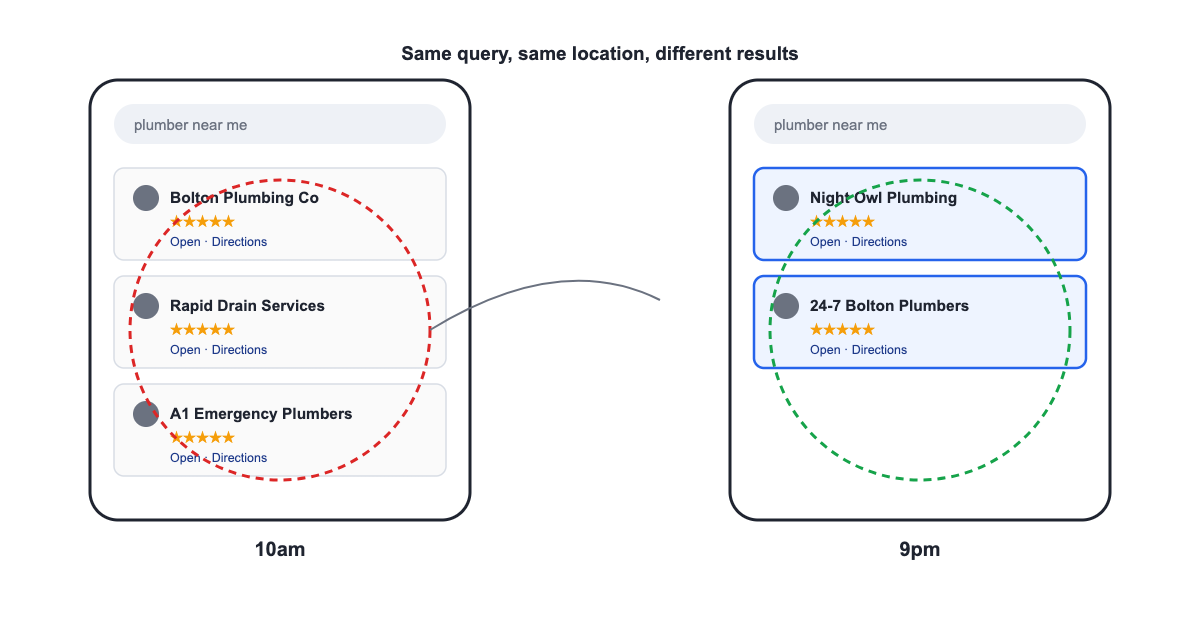
Your hours decide whether you exist right now. This is the one that surprises people. "Business is open at time of search" came in as the fifth most impactful local pack factor in the 2026 data. You can watch it happen live. A business sits comfortably in the pack during working hours, then slides out after closing while a competitor with longer hours takes the slot.
My position on that is not the popular one. I do not tell clients to fake 24/7 hours. If you run a shop and someone drives over at 9pm because Google said you were open, you have traded a ranking point for a one-star review, and review recency carries real weight now. For genuinely appointment-based businesses with an answering service, extending listed hours is defensible. For a bakery, it is self-harm.
Service area businesses have their own rules. If you hide your address, it should be because you genuinely serve customers at their location. Setting service areas that stretch beyond about a two-hour drive scored as a real suspension risk in the 2026 negative-factor list, and so did overlapping service areas across multiple profiles for the same brand.
One honest note on hidden addresses. Whitespark's Darren Shaw has written that he is not convinced hiding an address is a true ranking factor at all. He suspects that in some cases Google loses the geographic coordinates and re-pins the business somewhere else, which looks like a ranking collapse but is really a location problem. I have seen enough odd behaviour after address removals to think he is onto something. If rankings vanish after you hide an address, check where Google now thinks you are before you panic.
Gate 2: relevance, the entity match
Gate 2 is where search stops being about your business and starts being about language.
When someone types "emergency plumber near me", Google has to decide what class of thing that query is asking for. Then it has to decide which businesses belong to that class. In natural language processing terms this is entity classification and disambiguation. The system matches a query intent to an entity type, then matches entities to that type.
Your primary category is the strongest signal in that match. It ranked number one out of all 187 factors in the 2026 survey, above proximity, above reviews, above links. It is a classification rather than a keyword. Google offers over four thousand categories, and the list shifts month to month as new ones are added. Getting this right matters enough that I wrote a full breakdown on picking a primary category that matches the query rather than trying to cover it here.
Additional categories, at number eight on the list, widen the set of queries you are eligible for. Predefined services matter more than most people think. That factor entered the survey at number twenty-two after Joy Hawkins' research showed services genuinely move rankings. Services are the cheapest and fastest relevance lever available inside a profile, and most businesses leave the section half empty.
Keywords in the business title ranked third. I will be blunt about this. It works, and it is also the fastest way to get suspended if your legal name does not contain those words. In 2026 the negative-factors list put keyword stuffing at the top of the suspension risk pile. Do not stuff. Do report competitors who do, because "removal of spam listings through spam fighting" ranked nineteenth as a positive factor, which is a polite way of saying that cleaning up your local pack is itself an optimisation tactic.
Your landing page also has to agree with your profile. HTML NAP matching the profile's NAP ranked fifteenth. Keywords in the landing page title tag ranked seventeenth. Geographic keyword relevance of the content ranked eighteenth. What Google is doing here is corroboration, checking whether independent sources describe the same entity the same way. Your website is the highest-trust corroborating source you control.
Review text is relevance data too. "Keywords in native Google reviews" scored inside the top forty. Google runs entity extraction and sentiment analysis across review bodies, so the words your customers use become part of how your business is understood. You cannot script reviews, but you can ask a question that prompts the right vocabulary. "Would you mind mentioning which service we did for you?" is legitimate, and it works.
Gate 3: preference, the tiebreaker
Once a set of eligible, relevant businesses exists, Google sorts them. This is where most SEO advice lives, and it is the least useful place to start.
The strongest signals here are reviews and behaviour. High numerical ratings ranked sixth. Quantity of native reviews with text ranked ninth. Recency of reviews ranked eleventh, and sustained influx of reviews over time rather than bursts ranked fourteenth. Read those two together and the strategy writes itself. A steady trickle beats a campaign. Twenty reviews in one week followed by silence is a worse pattern than two a week for ten weeks, and it is more likely to trip a review filter.
Click-through rate from the pack ranked thirteenth. Engagement with the profile, meaning scrolling, opening photos and reading reviews, climbed to thirty-three. Your photos and your review replies are not only conversion assets. They are inputs.
Links still count, but lower than most agencies imply. The strongest link factor for the pack sat at twenty-five, well behind category, hours and reviews. Links do far more work on the organic side, which is a separate battle covered in building local landing pages that earn their own rankings.
The proximity ceiling
Here is the constraint nobody can sell you a solution for.
Proximity of the searcher to the business ranked second. Proximity to the city centroid ranked twelfth. Distance is not a factor you optimise. It is a boundary condition.
This is why I stopped trusting single-point rank tracking years ago. "We rank 3rd for dentist Manchester" is close to meaningless, because it describes one dot on a map. I use grid tracking instead, which checks the same query from dozens of coordinates around a business. The output looks like a heat map, green near the pin and fading to red at the edges.
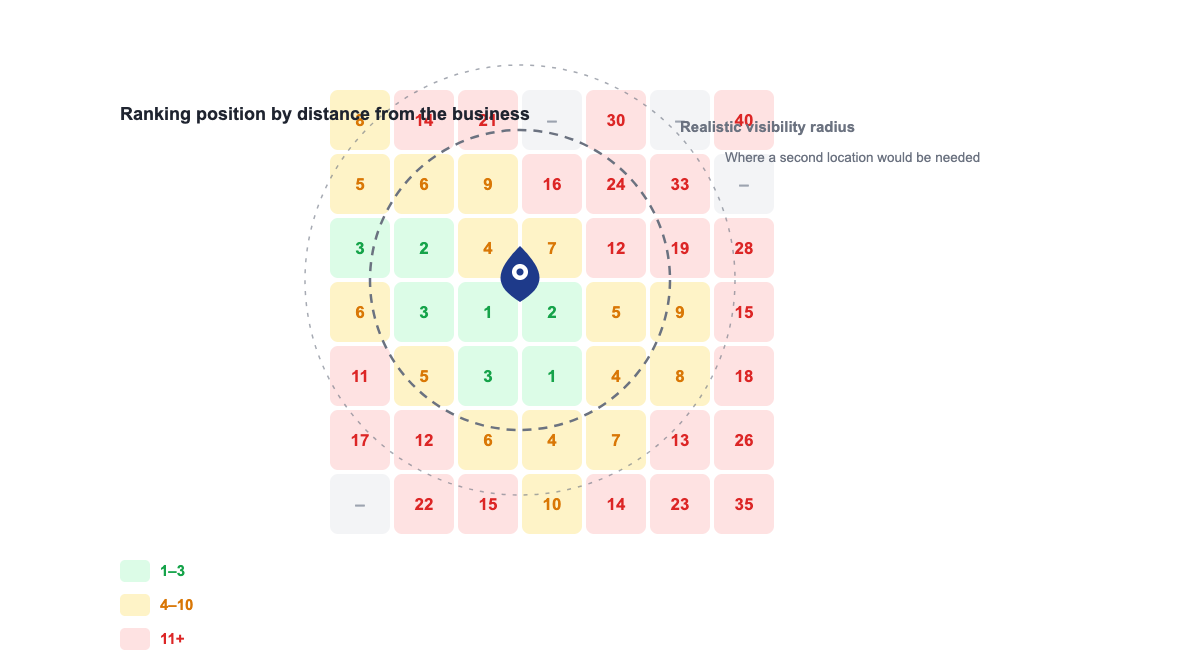
That map is the honest picture, and it reframes the goal. You are not trying to rank first everywhere. You are trying to expand the radius where you rank at all. Every gate 2 and gate 3 improvement pushes the green further out. None of them will let a single location dominate a whole metro area, and anyone promising that is selling you a story.
If a client genuinely needs coverage across a city, the answer is a second real location rather than more content. That is an expensive answer, which is why it is rarely the one people want to hear.
My diagnostic order
When someone tells me their map rankings dropped, I work through this order and I do not skip ahead.
- Is the profile still verified and clean? Check for suspension, merged duplicates and unapproved edits from the public.
- Did anything change on the profile in the last 60 days? Name, address, category, hours. Bulk edits in a short window are a known suspension trigger. Google keeps an edit history, so use it.
- Is the pin where it should be, and does the grid show green near the pin? If the green centre has moved, this is a location problem rather than a ranking problem.
- Do the hours match reality, and when did the tracking run? A ranking check run at 8pm on a business that closes at 6pm is measuring the wrong thing.
- Does the primary category still match the query I care about? Google occasionally retires or splits categories, and a profile can quietly land on a broader one.
- Are reviews still arriving? Look at cadence rather than total. A three-month gap shows up.
- Is the landing page still consistent with the profile? Site redesigns break NAP blocks constantly.
- Only now should you look at links, citations and content.
Roughly eight out of ten drops I investigate resolve at steps 1 to 5. Almost none of them resolve at step 8, which is where most people start.
What changed in 2026, and why rank is a worse metric now
Two shifts matter more than any individual factor.
The first is AI local packs. Sterling Sky's tracking found these appearing on around 7% of monitored keywords, currently mobile and US first. They show one or two businesses instead of three, they often surface different businesses than the classic three-pack, and they frequently drop the call button. When Places Scout compared the formats, AI local packs surfaced about a third as many unique businesses as traditional packs across the same query set.
The second is that paid units expanded fast. Local pack ads went from roughly 1% to 22% of tracked mobile reports across 2025, and Local Services Ads climbed from about 11% to 31% of tracked queries.
Put those together and you get the thing I now warn every client about. Your rank can hold steady while your calls fall. Sterling Sky's analysis of 179 profiles across 34 law firms showed exactly that pattern, with stable positions and declining clicks to call. If your only KPI is average map position, you will report a good quarter to a client who is losing money.
So I track leads, direction requests and calls alongside grid visibility, and I treat a call button disappearing as a reportable event. Visibility in AI answers is now its own workstream, which I cover in how AI search picks which local businesses to recommend.
Three mistakes I keep seeing
Optimising gate 3 while failing gate 1. Buying links for a business whose pin sits in the wrong suburb. The links are not wasted exactly, but they are being spent on the wrong constraint.
Treating the profile as a set and forget asset. Engagement signals rose in importance in the 2026 data. A profile with no new photos, no review replies and no service updates for a year is not neutral. It is losing ground to a competitor who does those things.
Chasing citation volume as a first move. Citation signals have been sliding down the weighting charts for a decade. They still matter for consistency, and increasingly for AI mentions, but the order of operations matters. Start with auditing your citations before building new ones.
Frequently asked questions
Why do I rank differently on my phone than on my laptop? Different device, different location signal, and sometimes a different result format. Mobile is where AI local packs and image-led packs are appearing first. Always specify the device and the coordinates when you compare results, otherwise you are comparing two different queries.
Does posting on my Google Business Profile improve rankings? Directly, barely. Post frequency sat near the bottom half of the 2026 factor list. Indirectly, posts give people something to engage with, and engagement signals did rise. I treat posts as a conversion and freshness tool rather than a ranking tactic.
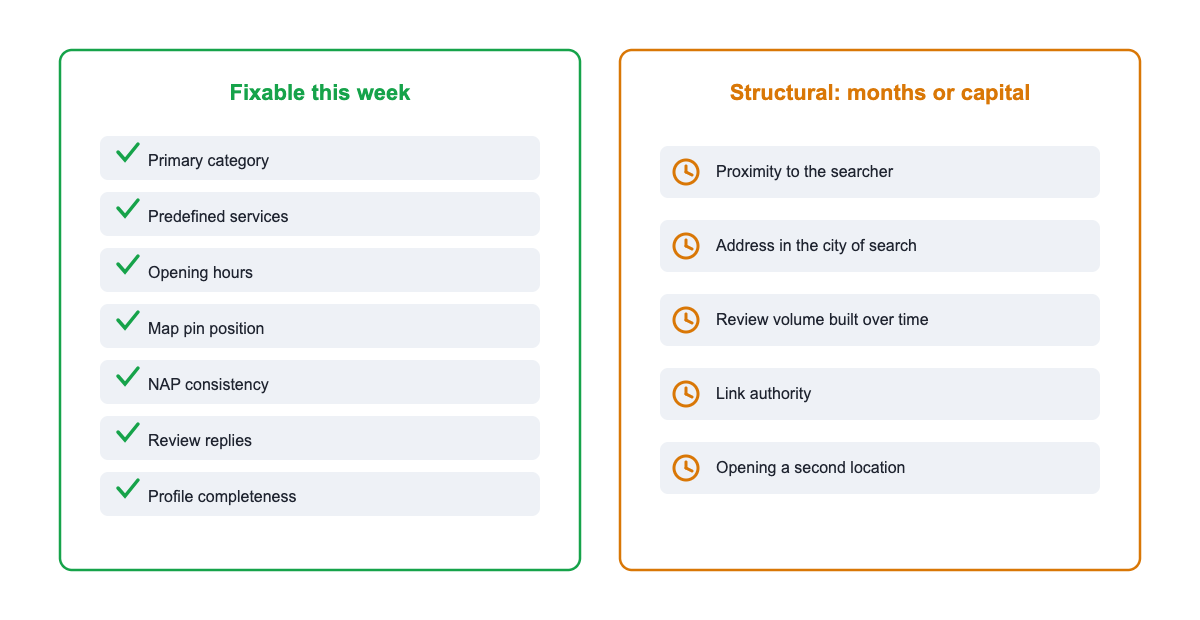
How long should a category change take to show up? Profile side changes like categories, services and hours are the fastest moving levers I work with, usually days rather than weeks. Review and link driven changes build far more slowly. If nothing moves within a couple of weeks after a category change, the problem is probably at gate 1.
Is proximity really unbeatable? Not unbeatable, but it is a strong boundary. A business with excellent relevance and prominence signals will out-rank a closer competitor with a weak profile. It will not out-rank a strong competitor who is also five minutes closer to the searcher. Widen the radius instead of fighting the centre.
Should I remove my address if I'm a service area business? If you genuinely do not serve customers at your premises, Google's guidelines say yes. Before you do, record your current grid rankings and note your verified address. If rankings shift afterwards, you will want to know whether Google moved your effective location rather than penalised you.
If you would rather have someone run this diagnosis on your own listing, grids and gates included, that is the work I do. You can see how I approach local search projects at rohanalvi.com.