Service Area Business SEO: How to Rank When You Do Not Have a Storefront
If you run a plumbing firm, a mobile locksmith, a cleaning company, or any business that goes to the customer rather than the other way round, you have probably had this conversation with yourself: "I serve twelve towns. Why do I only get calls from three of them?"
The answer is proximity, and proximity is the one local ranking input you cannot edit. Everything else in this article exists to work around that.
I want to be direct about something up front, because it saves people a lot of money. Adding towns to your service area settings does not make you rank in those towns. That setting tells customers where you will travel. It is not a ranking instruction. Businesses spend years believing otherwise, adding city after city, and wondering why the Maps visibility never spreads.
Storefront, service area, or hybrid: the question that decides everything
When you set up or edit a profile, Google asks whether customers come to your location. That answer sorts you into one of three types, and it has consequences most owners do not see coming.
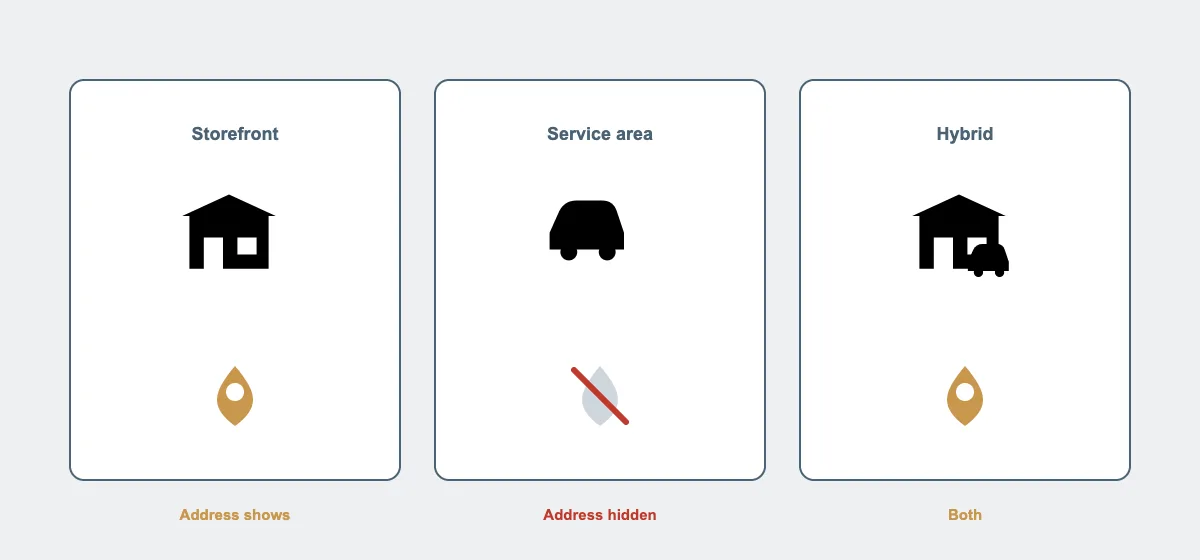
Storefront. Customers visit you at a staffed location during your stated hours. The address displays publicly on Maps.
Service area business. You travel to customers and do not receive them at your base. The address does not display. Instead, the profile shows the areas you serve.
Hybrid. Both. A tile showroom customers can walk into, with fitters who also go out to jobs. The address displays and a service area is defined around it.
The trap sits in the middle option. Selecting "I travel to customers" hides your address, and for a business run from home that is not a downside, it is a requirement. Google is explicit that a residential address should not display for a business that does not receive customers there. Displaying it anyway is one of the more common causes of a listing being pulled.
The other trap runs the opposite way. Businesses that genuinely do receive customers sometimes hide the address for privacy or because someone told them SABs rank better. They then lose the ability to appear as a storefront, which is a real cost in categories where people expect to visit.
Answer the question honestly based on how the business actually operates. If you get it wrong and need to change it later, that edit is a sensitive field change and it usually triggers fresh verification. Be prepared for what to do if your profile gets suspended, because address type changes are among the edits most likely to cause one.
The address still exists, it just does not show
This confuses people constantly, so it is worth stating plainly.
A service area business still gives Google a real physical address during setup. That address is used for verification, and it is used to calculate proximity. It simply is not published.
Which means the rules about what counts as a valid address still apply in full:
- PO boxes are not eligible.
- Mailbox rentals and virtual offices are not eligible.
- Invented suite numbers to separate two businesses at one address are not eligible.
- The address must be somewhere the business genuinely operates.
A home address works. A yard, a unit, or a warehouse works. A coworking desk you visit once a month generally does not, because the standard is real operation rather than a mailing point.
Buying a virtual office in the city centre to move your proximity is a strategy people still sell. It is a policy violation, it is detectable, and the listings built on it come down in waves rather than one at a time. I have picked up the pieces of several of these. The recovery is slower and more painful than just building coverage the legitimate way.
Video verification for a service area business is a different film
Most new profiles now route through video verification, and the guidance written for storefronts does not transfer.
A storefront video shows signage, the entrance, the interior, and someone performing a management action inside. A service area business usually has none of that to show.
What a SAB video should cover instead:
- The branded vehicle, including the livery and the number plate area if it carries branding
- Tools and equipment specific to the trade, ideally in the vehicle or a stored setup
- Business materials with the name on them: invoices, letterheads, uniforms, business cards
- Something proving location, such as a street sign near the base or the house or unit number
- A management action, such as signing into the profile dashboard on a device
Record it in one continuous take. No narration, no cuts, no faces, no bank details on screen. Keep it short but complete.
Repeated failures matter more than they used to, because multiple rejected attempts can push a listing toward a state where the verification options run out. Prepare properly for the first attempt rather than treating it as a draft.
Run the radius reality check before you plan anything
This is the exercise I run before making a single recommendation for a service area business, and it changes the conversation every time.
Pick your single most valuable query. Not a brand term. The one that produces booked jobs, for example "emergency electrician" or "carpet cleaning."
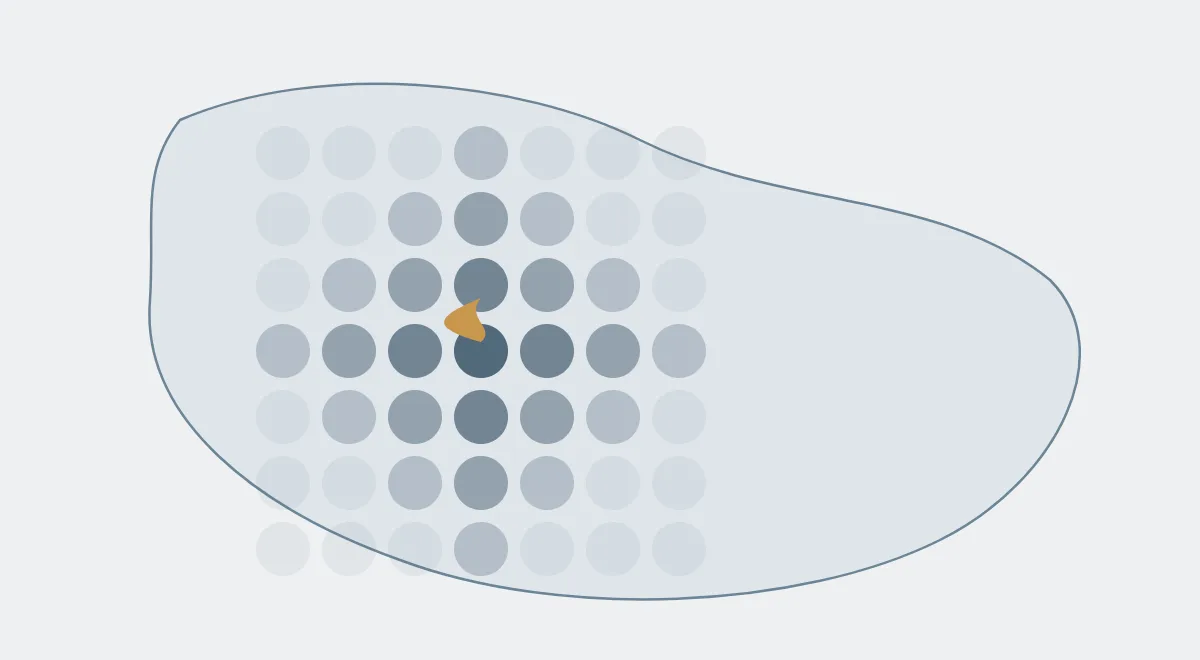
Then run a grid based rank check around your base. Most local rank tracking tools do this: they place a grid of points across a map and check your position at each one. Set the grid wide enough to cover your claimed service area, so if you say you serve a thirty mile radius, cover thirty miles.
What you get back is a map of reality. Almost always it looks like this:
- Top three positions in a tight zone close to the base
- Positions four to ten in a wider band
- Nothing at all past a certain distance
That falloff line is your true operating radius. It is usually much smaller than the service area listed on the profile. I have seen businesses claiming twenty five towns with a true radius covering three.
Do not treat this as bad news. Treat it as the planning input everything else depends on. Once you know where the profile stops working, you know exactly which areas need a different approach, and you stop spending profile effort on places the profile was never going to reach.
Re-run the grid quarterly. It is the only reliable way to see whether your radius is actually expanding.
Set your service areas properly, then stop touching them
Now that you know what the settings do and do not do, here is how to configure them.
Set areas you genuinely serve. If you would decline a job there, do not list it. This is not just a compliance point. A profile that claims a huge area while all its reviews come from one small zone reads as inconsistent.
Keep the count modest. Google allows a limited number of service areas, and its guidance points toward areas within roughly a two hour drive of your base. Listing the maximum number just because you can is not a strategy. I generally set areas that cover the true radius plus a realistic expansion band, not the whole county.
Prefer named towns and regions over ad hoc radius circles where the tool allows it, because they map to how people actually search.
Then leave them alone. Service area is a sensitive field. Editing it repeatedly is one of the change patterns that draws automated attention. Set it once, correctly.
Also spend real time on picking a primary category that matches what you do. For service businesses, the primary category is one of the strongest single levers on the profile, and a category that is too broad ("Contractor" instead of "Roofing Contractor") costs visibility on exactly the queries that make money.
The two ring coverage model
Here is the structure I use for every service area business, and it follows directly from the radius check.
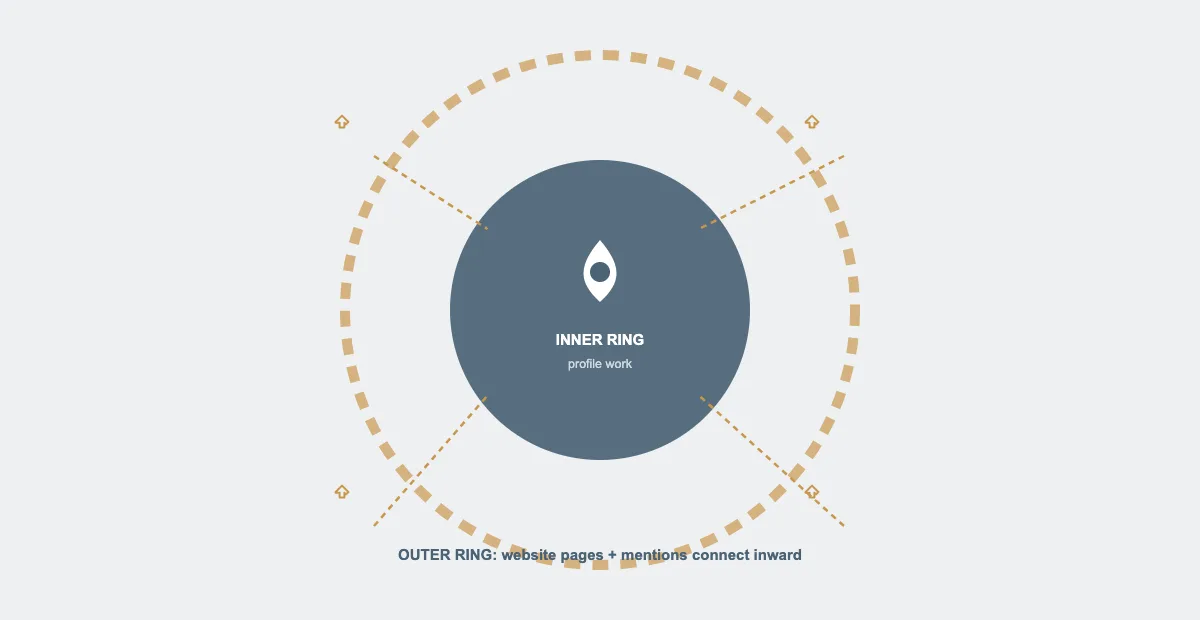
The inner ring is profile work. Inside your true operating radius, the Google Business Profile is doing most of the work. Optimise it properly: correct primary and secondary categories, complete service list, real photos, active review flow, accurate hours. Position gains here come from the profile and reviews far more than from the website. If you want a breakdown of what carries weight, the signals that determine local pack position covers it.
The outer ring is website work. Outside the radius, the profile is not going to appear in the pack no matter what you do. What can appear is your website, in the local organic results below the pack, and in AI generated answers that draw from web content rather than Maps.
That means location pages built for each area you serve are not an optional extra for a service area business. They are the only route into the outer ring. And they only work if they are genuinely different from each other. A template with the town name swapped in twelve times is not twelve pages, it is one page with twelve URLs, and it will be treated accordingly.
What makes a location page real for a service business:
- Jobs you have actually done in that area, described specifically
- Local conditions that affect the work (housing stock age, water hardness, common property types, parking or access constraints, council requirements)
- Response times and travel realities for that area, stated honestly
- Reviews from customers in that area, quoted with permission
- Named team members or vehicles that cover it
- Genuine photography from jobs there, not stock
That list is hard to fake, which is exactly why it works.
The rings connect through links and mentions. Earning links from organisations in the areas you serve, sponsoring things in the outer ring, and getting mentioned by local press out there is what slowly moves the falloff line outward. It is the only legitimate mechanism for expanding a radius other than opening a real second location.
Mistakes I see repeatedly
Stuffing the business name. "Ace Plumbing" becomes "Ace Plumbing Emergency Plumber Birmingham Coventry Solihull." It works for a while. Then it stops working permanently.
Creating a second listing for the same business in another town. Every profile needs a real, distinct, staffed location. A second listing at a friend's address is a duplicate, and duplicates take the original down with them.
Believing photo geotags help. EXIF location data in your uploaded photos is not a ranking input. Tools that promise ranking gains from geotagged image uploads are selling you nothing. Upload real photos because they convert visitors, not because of the metadata.
Chasing the city centre. Businesses on the edge of a metro area often obsess over ranking in the centre, where competition is highest and proximity is worst. The nearer suburbs are usually easier, closer, and more profitable per job.
Ignoring the review geography. If every review mentions the same suburb, your review corpus is confirming a small radius. Ask for reviews after jobs in the outer areas too. It costs nothing and it is one of the few genuinely useful things you can do about geographic breadth.
A service area business has fewer levers than a storefront, so the ones it does have need to be pulled correctly. If you are claiming twenty towns and getting calls from four, the fix usually starts with measuring the real radius before changing anything. That is the first thing I do on this kind of account, and you can see how I work at rohanalvi.com.
Frequently Asked Questions
Do service area settings affect where I rank? No, not directly. They tell customers where you travel and can affect whether your profile is considered relevant to some queries, but they do not extend the radius in which your profile competes for local pack position. Proximity to your verified address is what drives that.
Can I have a Google Business Profile without an address? You cannot have one without giving Google an address. You can have one where the address is not displayed publicly, which is what a service area business is. The address still has to be a real place where the business operates, and PO boxes and virtual offices do not qualify.
How many service areas should I list? Enough to cover the areas you genuinely serve, and no more. Google's guidance points to areas within roughly a two hour drive. Listing the maximum number available is not an advantage and it makes the profile less coherent.
Can a service area business rank in a town twenty miles away? The profile itself, usually not in the local pack. Your website can rank in local organic results for that town if you have a genuinely useful page for it and some link and review signals connected to the area. That is the realistic route to outer ring coverage.
Should I switch from storefront to service area business? Only if it reflects how you operate. Hiding a real, staffed, customer facing address costs you storefront visibility. Displaying an address customers never visit risks removal. Match the setting to reality, and change it once rather than experimenting.
What should my verification video show if I work from home? Focus on the business rather than the house. Branded vehicle, tools and equipment, business documentation, uniforms, and something establishing the street location such as a nearby street sign or the property number. One continuous take, no narration.