How AI Search Decides Which Local Business to Recommend
Let me start by disagreeing with most of what is written about this topic.
The common story goes like this. Everyone is asking ChatGPT for restaurant recommendations now, so you need to optimise for ChatGPT, and here are seven tips. I do not think that story is accurate, and acting on it will send your budget in the wrong direction.
Joy Hawkins looked at one of Sterling Sky's largest multi-location clients and found that AI assistant traffic went from around 0.1% of what Google sent to about 2%. Real growth, and still a rounding error. It was also only around a fifth of what Bing was sending that same site.
So no, AI assistants are not yet a meaningful traffic source for most local businesses.
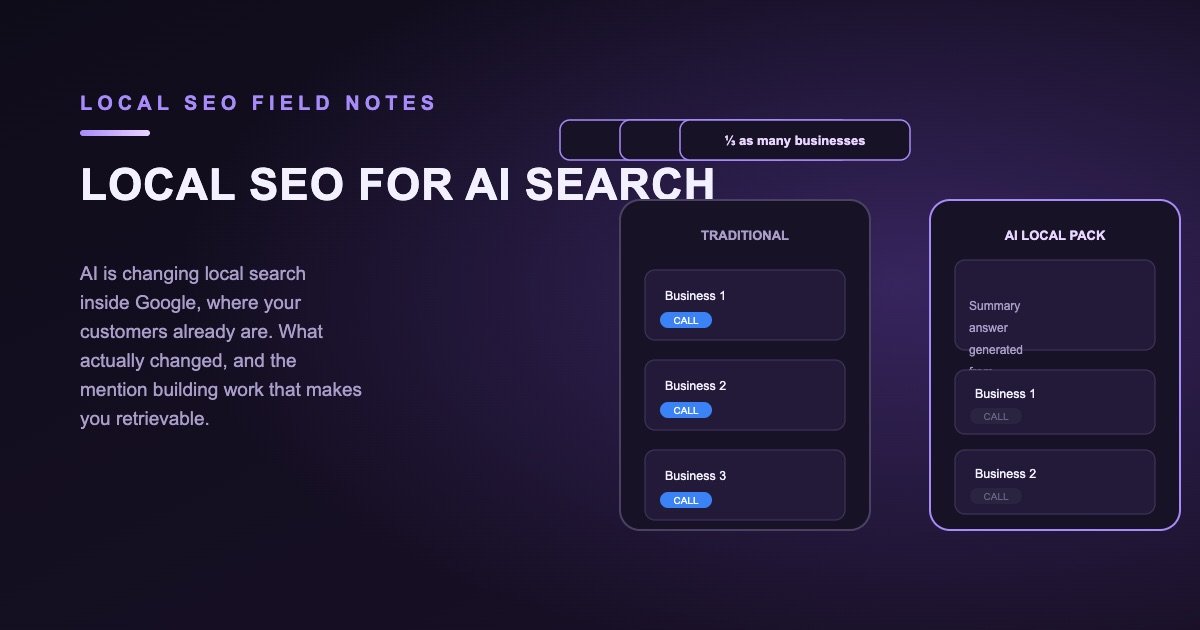
What is happening, and what matters far more, is that AI is changing local search inside Google, where your customers already are. That is the problem worth solving.
What actually changed
Two shifts, both documented, both affecting revenue right now.
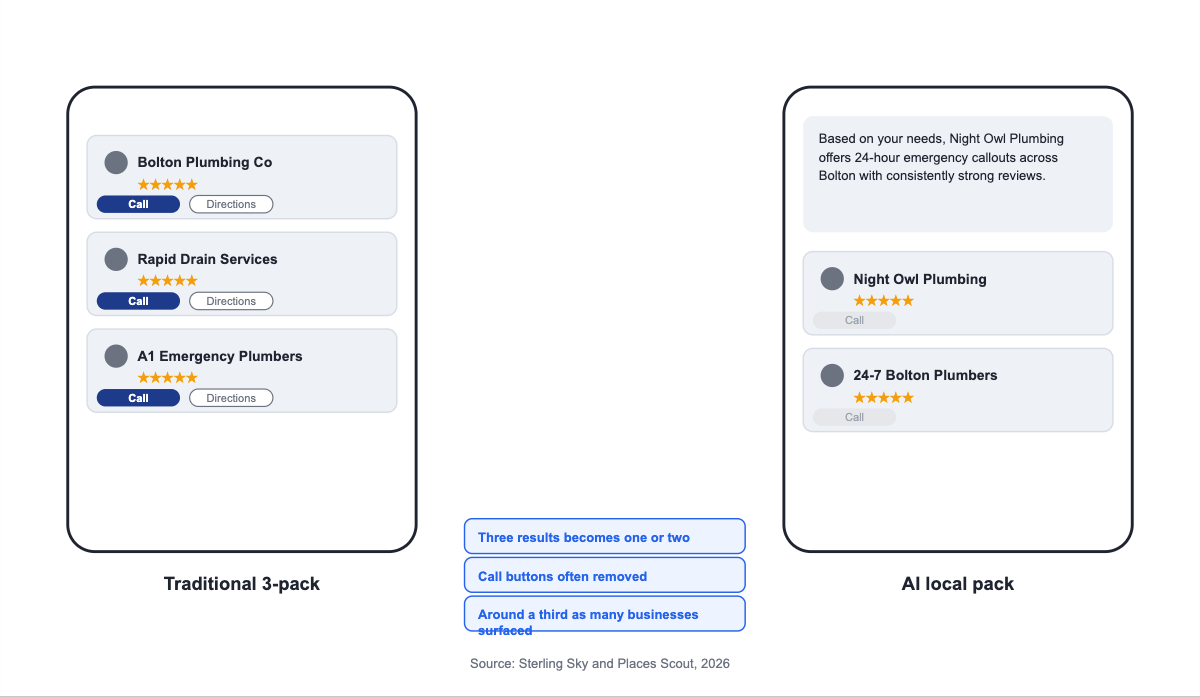
AI local packs are surfacing fewer businesses. Sterling Sky has been tracking these, currently mobile first and appearing in the US, on around 7% of the keywords in their client reports. Three things make them a problem. They show one or two businesses instead of three. They often show different businesses than the traditional pack. And they frequently drop the call button.
When Places Scout compared the two formats across the same query set, AI local packs surfaced 5,943 unique businesses against 18,330 in classic three-packs, which is roughly a third. Across 322 markets analysed, 88% showed fewer unique businesses in the AI version.
That is the headline nobody should skip. The AI format is a narrower funnel, and fewer businesses get shown at all.
The call button is disappearing. Separately from AI packs, Google has been replacing call buttons with images in several industries. Sterling Sky's data across 179 profiles at 34 law firms showed clicks to call declining steadily over two years, while website clicks held up better because the website icon still appears on desktop.
Put those together and you get the pattern I now brief every client on before we start. Your rankings can stay exactly where they are while your phone stops ringing.
Ranking and retrieval are different problems
Traditional local search ranks businesses. AI search retrieves, then composes.
The difference is not academic. A ranking system orders a list of candidates. A generative system runs one or more retrievals, pulls back documents and structured data, then writes an answer grounded in what it found. If your business is not in what came back, you are not in the answer. There is no position eleven. You are either in the retrieved set or you are invisible.
There is a second step that trips people up. These systems are built to be cautious about facts. Before stating that you exist, are open, do that service and are good at it, the system wants that claim to appear in more than one place. Different independent sources agreeing about the same entity is corroboration, and corroboration is what makes a claim safe to repeat.
That gives me the model I actually use.
Your corroboration set
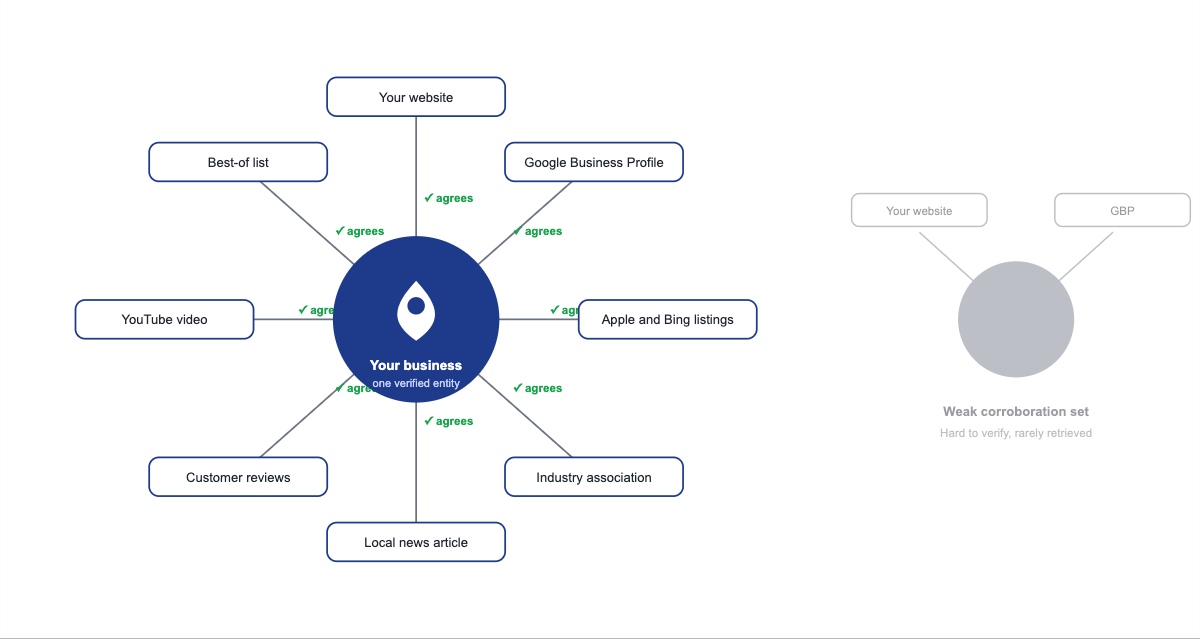
Your corroboration set is everything a machine can independently verify about your business. Not what you say about yourself, but what others say, plus what you say, where the two agree.
A strong corroboration set looks like this.
- Your website says you are an emergency plumber in Bolton.
- Your Business Profile says the same, with the same name, address and phone.
- Three directories say the same.
- Your industry association lists you under the same classification.
- A local news article mentions you doing emergency work in Bolton.
- Forty reviews mention burst pipes, emergency call-outs and Bolton suburbs by name.
- A YouTube video shows your van and your team.
Every one of those is a separate statement about the same real world entity. When a system tries to answer who is a good emergency plumber in Bolton, you are easy to retrieve, easy to verify and safe to recommend.
A weak corroboration set is a good website and nothing else. That business might rank fine in classic organic results. It is a bad candidate for retrieval, because there is nothing to corroborate against.
Three surfaces, three different jobs
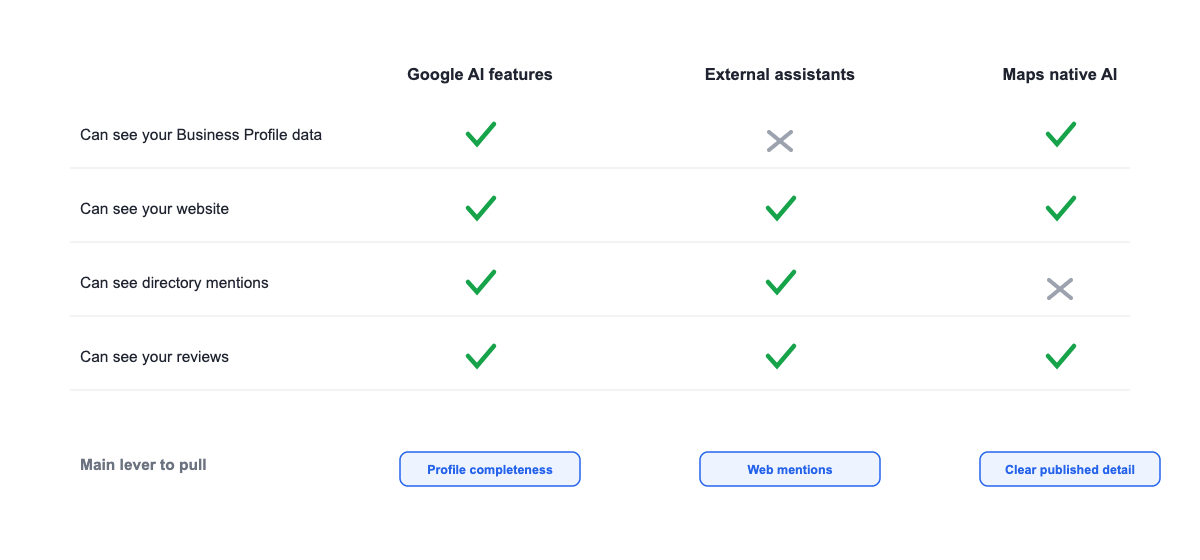
This is where most advice goes wrong, because it treats AI search as one thing. It is at least three, with different data access.
Surface one, Google's AI features. AI Overviews, AI Mode and AI local packs. These have full access to Business Profile data, including categories, services, hours, reviews and attributes. Darren Shaw made this point sharply while scoring the 2026 survey. He would rate additional categories as worthless for ChatGPT but meaningful for Google's own AI, because only Google has that data.
What to do here is everything you were already doing, because your profile is the data source. This is why categories only help you on Google's own surfaces is a real constraint rather than a technicality, and why the classic local pack fundamentals still decide most of this.
Surface two, external assistants. ChatGPT, Claude, Perplexity and the rest. No Business Profile feed. They work from a web corpus plus whatever live search partner they use. Your categories are invisible to them. Your web presence is not.
What to do here is be mentioned across the open web, in text a crawler can read, on sites that get crawled often.
Surface three, Maps native AI. Google has retired the old owner answered Q&A section on Business Profiles and replaced it with a Gemini powered assistant inside Maps that answers visitor questions live, generating responses from profile data, the linked website and reviews.
This one is worth pausing on, because it quietly changed a workflow. The old approach was to seed your own Q&A with useful questions and answers. That lever is gone. The assistant now answers from whatever you have published. A vague profile description, an empty services list, or a website that contradicts your listing all become bad answers given to a customer standing outside your door.
What the evidence says actually drives AI visibility
Two datasets are worth knowing.
Whitespark's 2026 survey added an AI search visibility score for every factor. The finding that surprised the author most was that three of the top five AI visibility factors were citation factors. Citations had been declining for a decade as a ranking lever. In AI search, mentions are the new link.
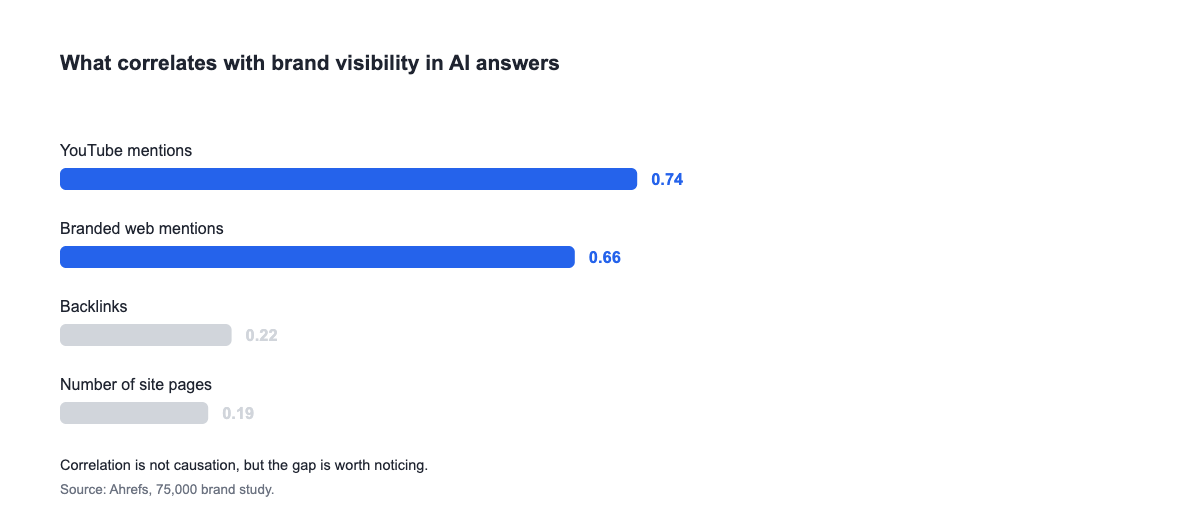
Ahrefs' study of 75,000 brands across ChatGPT, AI Mode and AI Overviews found the following:
- YouTube mentions showed the strongest correlation with AI visibility, around 0.74.
- Branded web mentions correlated at roughly 0.66 to 0.71.
- Backlinks correlated far more weakly, around 0.22.
- Number of pages on a site had almost no relationship, around 0.19.
- About a quarter of the brands studied had zero mentions in AI Overviews.
- The three assistants largely mention the same brands as each other.
Correlation is not causation, and Ahrefs said so themselves. But the shape of it is consistent with how retrieval works, and it points in an uncomfortable direction for anyone whose plan is to publish more content.
Content volume is not the lever. Being mentioned is. Publishing fifty thin local pages is close to the least efficient way to get mentioned that I can think of.
The playbook I actually run
Six things, in the order I do them.
1. Fix the entity record first. One consistent name, address and phone across every surface that carries it. Conflicting data is the fastest way to be treated as an uncertain entity. This is the foundation, and I cover it fully in building the mentions AI systems retrieve.
2. Complete the Business Profile properly. Every field, including services, attributes, hours and a clear description. On Google's AI surfaces this is the primary data source, and inside Maps it is now literally what the assistant reads to answer people.
3. Write pages that can be extracted from. Open with a plain factual sentence using subject, predicate and object. Answer the question in the first paragraph rather than after eight paragraphs of preamble. Use real headings, short paragraphs and clear lists. This is the same shift Whitespark flagged in the 2026 report, where content volume on service pages dropped sharply in importance. Machines and humans both want the answer rather than the preamble. There is more in writing pages that machines can extract from.
4. Build mentions rather than links. Local press. Industry associations. Sponsorship pages. Expert curated best-of lists, which Darren Shaw specifically called out as an AI era priority, and which usually means asking to be considered. Supplier and partner pages. Community involvement that produces a published page with your name on it.
5. Diversify where reviews live. Review requests have gone to Google by default for years. If assistants pull from the wider web, reviews on prominent industry specific platforms carry weight that Google-only reviews cannot. Also put a real testimonials page on your own site and link it from the main navigation. It sounds basic, and it gives a retrieval system something to find.
6. Consider video seriously. The YouTube correlation in the Ahrefs data was the strongest single signal they measured, and notably, brands mentioned in low view videos were not much disadvantaged as long as they were mentioned widely. For a local business that is unusually achievable. You do not need a viral channel. You need to be named in videos about your area and your trade.
What I would not do
Do not build an AI content strategy that just means publishing more articles. The correlation between page count and AI visibility was close to zero. This is the most commonly sold answer and one of the least supported.
Do not fill your profile or website with AI generated text and images. The 2026 negative factor list scored AI generated content on profiles as a real quality problem, and AI generated photos alongside it. There is a genuine irony in damaging your AI visibility by publishing AI slop, and it happens constantly.
Do not abandon what works because AI is loud. The classic local pack still drives the overwhelming majority of local discovery. Darren Shaw's own view in the 2026 report was that local search has stayed relatively insulated from the AI upheaval that flattened informational publishers, because Google's local results are simply a better experience for local intent than a chat response.
Do not over-invest in prompt chasing. Testing whether you appear for "best plumber in Bolton" in three assistants is a useful spot check. It is not a strategy, and the results are unstable between sessions.
How I measure it
Three things, and I keep expectations honest about all of them.
Referral traffic from assistants in analytics. Segment it and track the trend. Also track whether it converts, because traffic that does not convert is not a win, and early data on assistant referrals is mixed.
Presence checks on a fixed prompt set. Ten to fifteen prompts a real customer might use, checked on the same schedule, from the same location, logged in a sheet. Watch direction of travel rather than any single result.
Mention count across the open web. This is my leading indicator. If mentions are climbing, AI visibility tends to follow. If mentions are flat, nothing else you are doing will move it.
There is one more metric I have added to every local report. Conversions and calls, tracked separately from rankings. The single most likely thing to happen this year is that your positions hold and your calls fall, and no ranking report will explain that to your client.
Frequently asked questions
Should I be worried about AI local packs? Aware rather than panicked. They currently appear on a minority of queries, on mobile, and US first. But they surface roughly a third as many businesses as classic packs and often drop the call button, so the impact where they do appear is significant. Watch your calls, not just your positions.
Does my Google Business Profile affect ChatGPT results? Not directly. External assistants do not have a Business Profile data feed. They see your website, directories, review platforms, news coverage and social content. Google's own AI features are a different story, because they have full profile access.
Is schema markup the answer to AI visibility? It helps machines parse a page and it is worth having. It ranked mid table for AI visibility in the 2026 survey and low for local pack. It is a clarity aid rather than a shortcut, and it cannot make a business with no mentions retrievable.
How do I get listed on those best-of lists? Usually by asking, with evidence. Find the lists that already rank for your key queries, work out who maintains them, and make a genuine case. Most try to stay editorially independent, so it is a slow, human process. It is also one of the few AI era tactics with a clear evidence base behind it.
Do reviews affect AI recommendations? Almost certainly. Reviews are text, they are indexed, and they contain the vocabulary a system uses to decide what you are good at. The practical shift is spreading reviews across the platforms your industry actually uses instead of sending every request to Google.
How much should a small local business invest here? Honestly, not much yet as a separate line item. Most of the work that improves AI visibility is work you should be doing anyway, including a clean entity record, a complete profile, clear pages and genuine local mentions. Do those well and you are most of the way there without a dedicated AI budget.
The uncomfortable version of all this is that the fundamentals did not change, but the payoff for getting them exactly right went up. If you want someone to audit your entity record, your profile and your mention footprint together rather than in pieces, that is the work I do at rohanalvi.com.